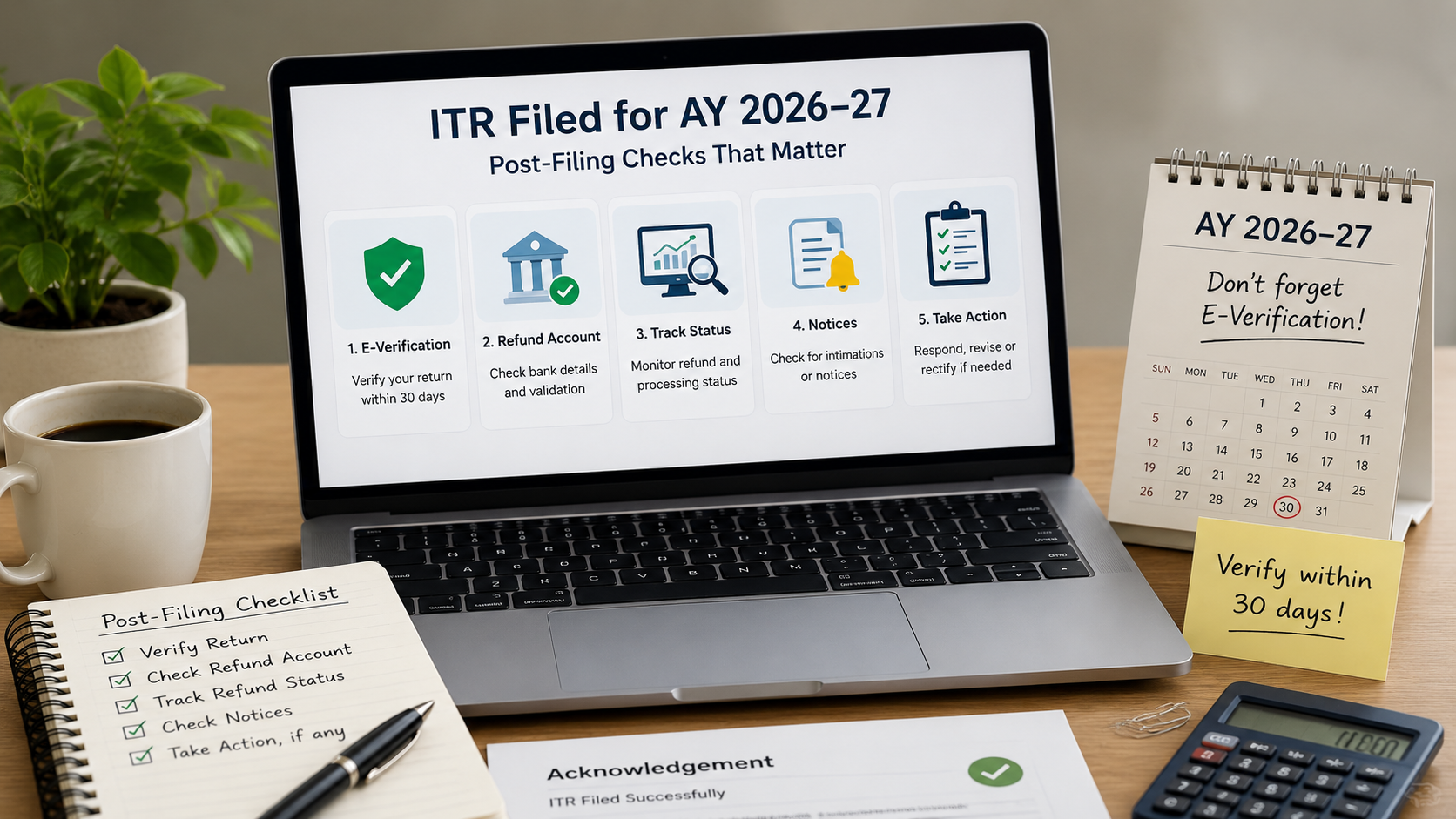
Filing your income-tax return is not the last step. For FY 2025–26, relevant to AY 2026–27, first confirm that the return was verified within 30 days of filing. Next, check the bank account nominated for refund, download the acknowledgement, and monitor the portal for an intimation, proposed adjustment or defective-return notice.
Most post-filing problems are easier to correct when noticed early. The practical question is not merely whether the return was uploaded, but whether it is verified, ready for processing and free from an unresolved communication.
1. Verify the return within 30 days#
A return filed online must be verified. The Income Tax Department allows 30 days from the date of filing for e-verification or submission of the signed ITR-V. Available verification methods include Aadhaar OTP, net banking, eligible bank or demat EVC and digital signature, depending on the taxpayer.
Log in and check the return under e-File → Income Tax Returns → View Filed Returns. Do not rely only on the acknowledgement number or confirmation from the person who uploaded the return. The status should show that verification is complete.
Where verification is completed after the permitted period, filing-date and delayed-filing consequences may arise. An unverified return should therefore be addressed promptly rather than left pending while waiting for a refund.
2. Check the refund account and save the filed return#
Confirm that the bank account selected for refund is active, validated and nominated on the e-filing portal. Only a validated bank account can be nominated to receive an income-tax refund. Check the PAN linkage, account number and IFSC details, particularly where an old or closed account appeared in the return.
Download and retain the acknowledgement and complete filed ITR. Keep them with Form 16, Form 26AS, AIS/TIS, tax challans, capital-gain statements and documents supporting material deductions or exemptions.
These records make it easier to compare the return with the intimation issued after processing.
3. Read the portal status before taking action#
A refund taking time does not automatically mean that the return is defective. First identify the status or communication shown on the portal.
| Portal status or communication | What it generally means | Practical response |
|---|---|---|
| Pending for verification | The return was uploaded but verification is incomplete | Verify immediately and check the 30-day limit |
| Successfully verified | Verification is complete and processing may be pending | Monitor the return unless you identify an error |
| Intimation under section 143(1) | CPC has processed the return | Compare the income, tax credits, refund or demand with the filed return |
| Proposed adjustment under section 143(1)(a) | CPC proposes a prima facie adjustment | Review the difference and respond within the stated time |
| Defective-return notice under section 139(9) | The return contains incomplete or inconsistent information | Correct the defect or submit reasons for disagreement within the time allowed |
| Refund failed | The bank credit was unsuccessful | Correct the bank details and request refund reissue |
Proposed adjustments and defective-return notices can be viewed through Pending Actions → e-Proceedings. The e-Proceedings service allows taxpayers to view and respond electronically to communications issued by CPC or another income-tax authority.
Read the complete communication before responding. An email or SMS alert is only a notification; the notice available on the portal contains the relevant issue, amount and response period.
4. Should you revise, rectify or respond?#
The correct route depends on when the error is identified and whether CPC has already processed the return.
A revised return is generally appropriate when you discover your own filing error. Examples include omitted bank interest, an incorrect deduction, a missing tax challan or information entered in the wrong schedule.
For AY 2026–27, a revised return may be filed up to 31 March 2027 or before completion of assessment, whichever is earlier. Where it is filed after 31 December 2026, a fee of ₹1,000 applies if total income does not exceed ₹5 lakh and ₹5,000 in other cases.
A rectification request is generally considered after an intimation or order where there is a mistake apparent from the record. It should not ordinarily be used to report new income or introduce a fresh claim that should have been included through a revised return.
A notice response is required when CPC or another authority has specifically requested a correction or explanation. A defective-return notice ordinarily allows 15 days from receipt, or the period stated in the notice. The defect should be corrected within the permitted time.
5. Example: expected refund becomes a demand#
Meena, a salaried employee in Chennai, filed her AY 2026–27 return showing a refund of ₹28,000. Her income was correctly reported, but a self-assessment-tax challan was entered using incorrect details.
CPC could not match the tax credit, and the intimation showed a demand instead of the expected refund.
Meena should not immediately pay the same tax again. She should compare the challan, Form 26AS, filed return and intimation. If the return has not been processed, revision may be appropriate. If an intimation has already been issued and the tax payment is available in the records, correction of the tax-credit details or rectification may be considered.
The important step is to understand why the mismatch arose before choosing revision, rectification or payment.
6. Complete this five-minute post-filing review#
- Confirm that the return is verified and save the acknowledgement.
- Compare the final ITR with the income and tax-credit records used for filing.
- Validate and nominate the intended refund bank account.
- Check Pending Actions and the registered email for communications.
- Read any intimation fully before accepting a demand or seeking rectification.
- Where a refund has failed, correct the bank details and submit a refund-reissue request.
Frequently asked questions#
How soon will the refund be received?
There is no single processing period for every return. Verification, data matching, tax-credit claims and pending communications can affect processing. Track the actual return status on the portal instead of relying on informal refund timelines.
Can a small difference in the intimation be ignored?
No. Compare the intimation with the filed return even where the amount is small. An unexplained difference may reduce the refund, create a demand or affect the tax records carried forward.
What if the refund status shows “failed”?
Check whether the bank account is active, validated and nominated. After correcting the bank details, submit a refund-reissue request through the e-filing portal.
Official references#
Disclaimer#
“The information in this article is intended solely for general educational purposes and is based on the provisions and guidance available as on the date of review. It does not constitute professional advice or a professional opinion. The applicable treatment may differ depending on the facts and circumstances of each case.”