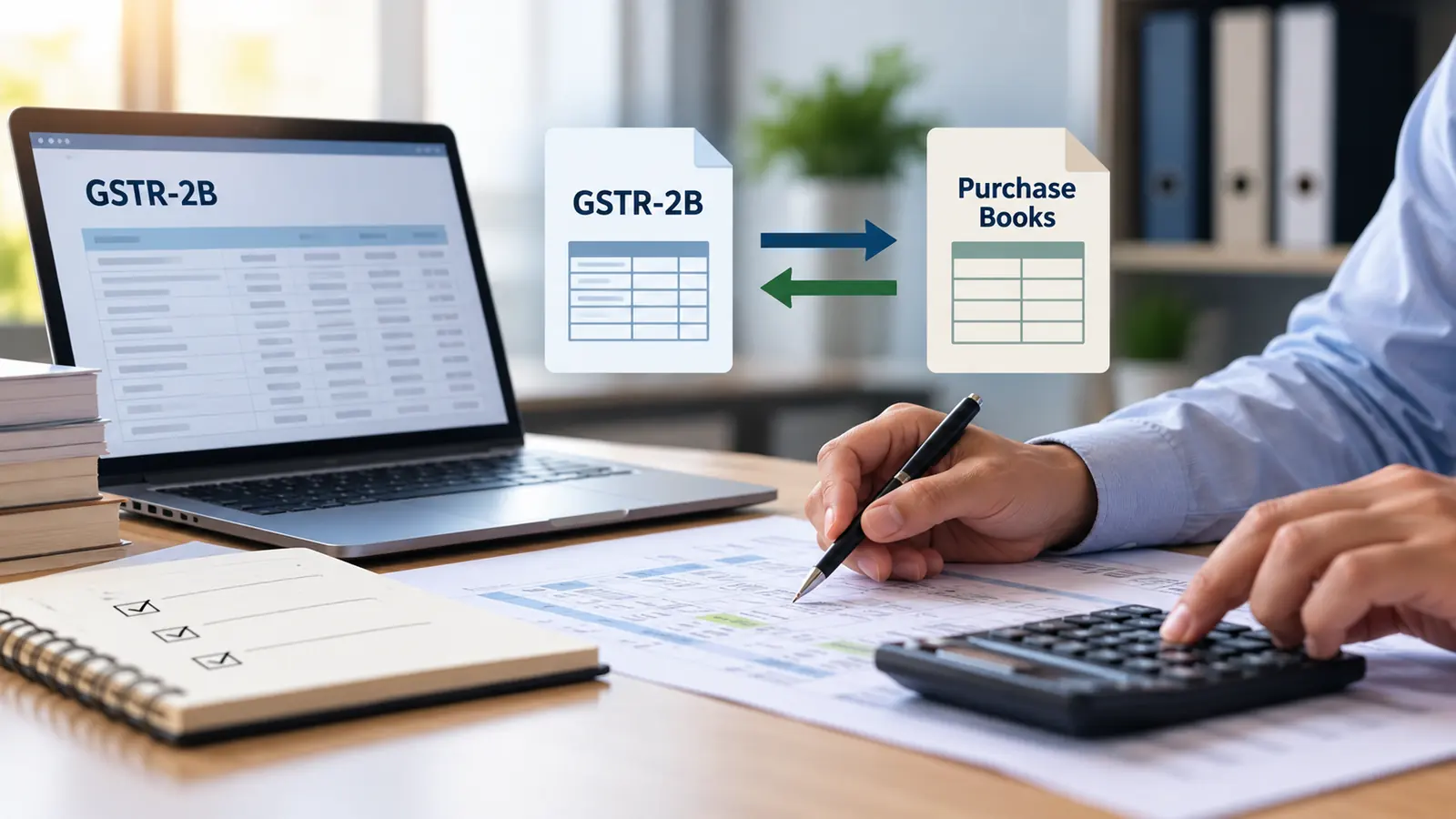
A mismatch does not automatically mean that ITC is lost#
If the Input Tax Credit (ITC) appearing in GSTR-2B does not agree with the purchase register, the difference should be identified before filing GSTR-3B. GSTN advises taxpayers to reconcile GSTR-2B with their own books and records and to ensure that credit is not availed twice and required reversals are made.
For ordinary invoices required to be reported by the supplier under section 37, an invoice recorded in the books but not reported by the supplier and communicated to the recipient through GSTR-2B cannot, by the book entry alone, satisfy the supplier-reporting condition for ITC. From 1 January 2022, section 16(2)(aa) and Rule 36(4) link availment of such ITC to supplier reporting and communication to the recipient.
At the same time, an invoice appearing in GSTR-2B does not automatically make the credit eligible. Section 16 contains other conditions for ITC, and section 17 can restrict or block credit in specified situations. GSTN also states that there can be cases where ITC appearing in GSTR-2B is not legally available and must be self-assessed by the taxpayer.
A practical reconciliation sequence is therefore:
Purchase books → GSTR-2B/IMS reconciliation → ITC eligibility review → GSTR-3B.

Why can the purchase register and GSTR-2B differ?#
The purchase register comes from the business's accounting records. GSTR-2B is an auto-drafted ITC statement generated from information including suppliers' GSTR-1/GSTR-1A/IFF, GSTR-5, GSTR-6 and import information received through ICEGATE.
Because the two records come from different sources, the reconciliation should be performed document by document rather than by comparing only the total ITC.
A useful classification is:
| Reconciliation result | What should be checked |
|---|---|
| In books and in GSTR-2B | Check whether the other ITC conditions and restrictions are satisfied |
| In books but not in GSTR-2B | Check whether the supplier has furnished the invoice and whether it has been communicated in GSTR-2B |
| In GSTR-2B but not in books | Verify the invoice, the underlying supply and whether the statutory ITC conditions are satisfied |
| Present in both but values differ | Reconcile the invoice/debit note/credit note and tax values before determining the ITC |

This approach follows GSTN's instruction to reconcile GSTR-2B with the taxpayer's own books and to self-assess the credit ultimately taken in GSTR-3B.
GSTR-2B availability is only one part of ITC eligibility#
Section 16(1) permits ITC on supplies used or intended to be used in the course or furtherance of business, subject to the prescribed conditions and restrictions.
Section 16(2) includes conditions such as:
- possession of the prescribed tax invoice, debit note or other tax-paying document;
- supplier reporting and communication of relevant invoice/debit-note details;
- receipt of the goods or services, subject to the statutory deemed-receipt provisions;
- communicated ITC not being restricted under section 38;
- tax charged on the supply having been actually paid to the Government, subject to the provision; and
- furnishing of the return under section 39.
Section 17 can separately restrict credit where goods or services are used partly for non-business purposes or partly for exempt supplies, and also contains specified blocked-credit provisions.
Section 16 also deals with the consequence where the recipient does not pay the supplier the value of supply together with tax within 180 days from the invoice date, subject to the statutory exclusions. The Act permits re-availment after the prescribed payment is subsequently made.
There is also a statutory time limit. Subject to the specific exceptions contained in section 16, section 16(4) restricts ITC after 30 November following the end of the financial year to which the invoice or debit note pertains, or furnishing of the relevant annual return, whichever is earlier.
Therefore, “available in GSTR-2B” and “eligible ITC” are not necessarily the same amount.
Example: books show ₹1,80,000 ITC but GSTR-2B shows ₹1,62,000#
Assume a trading business has purchase invoices carrying total GST of ₹1,80,000 for a month.
Its GSTR-2B contains corresponding ITC of ₹1,62,000. An invoice carrying GST of ₹18,000 is present in the purchase register but has not been communicated in GSTR-2B.
For an ordinary invoice required to be furnished by the supplier under section 37, the ₹18,000 cannot be treated as eligible merely because the invoice has been entered in the purchase register. The supplier-reporting and communication requirement under section 16(2)(aa) and Rule 36(4) must also be satisfied.
Now assume that, within the ₹1,62,000 appearing in GSTR-2B, GST of ₹9,000 relates to goods that have not yet been received by the business and none of the deemed-receipt situations under section 16(2)(b) applies.
That ₹9,000 does not presently satisfy the receipt condition merely because the invoice appears in GSTR-2B.
If the remaining ₹1,53,000 satisfies the other applicable ITC conditions and restrictions, that amount can then be considered in determining the ITC to be reported in GSTR-3B.
The example demonstrates the two separate checks:
Does the document appear in GSTR-2B?
and
Does the credit satisfy the statutory conditions for ITC?
Where does IMS fit into this process?#
For supplier-reported records relevant to this article, the Invoice Management System (IMS) enables recipients to take specified actions such as Accept, Reject or Pending, depending on the type of record and the functionality available for that record.
Where no action is taken on records for which the deemed-acceptance treatment applies, the system treats them as accepted for GSTR-2B generation. GSTN specifically states that taking action in IMS is not mandatory merely for generation of GSTR-2B.
GSTN also states that rejection should be exercised carefully because rejection results in no ITC for the recipient. Its guidance gives, as an example, a record that does not pertain to the recipient.
Where an IMS action is taken or changed after generation of the draft GSTR-2B and before filing the corresponding GSTR-3B, GSTR-2B is required to be recomputed so that the changed action is reflected. GSTN states that such recomputation is mandatory where the recipient changes or takes action after draft GSTR-2B generation.
A practical monthly ITC control#
Before finalising GSTR-3B, an invoice-level reconciliation can record:
- supplier GSTIN, invoice number and date;
- taxable value and GST as per books and GSTR-2B;
- whether the document appears in both records;
- IMS status, where relevant;
- ITC eligibility or reversal treatment; and
- the tax period in which ITC is finally availed or re-availed.
This is a reconciliation format for business use, not a statutory form prescribed under the GST law.
It is also relevant to recognise Rule 88D. Where ITC availed in GSTR-3B exceeds the ITC available in GSTR-2B by the amount and percentage contemplated by Rule 88D, the registered person may receive an electronic intimation in Part A of FORM GST DRC-01C. The rule provides for payment of the specified excess amount with applicable interest through DRC-03 or an explanation of the difference on the common portal.
Accordingly, two points should be separately checked before ITC is reported:
- an invoice should not be treated as eligible merely because it appears in GSTR-2B; and
- for ordinary invoices covered by section 37, a book entry alone does not replace the supplier-reporting and GSTR-2B communication condition.
Frequently asked questions#
1. If an invoice appears in GSTR-2B, can the full ITC be claimed?
Not automatically. The taxpayer must also satisfy the applicable conditions and restrictions under the CGST Act and Rules. GSTN expressly states that there may be situations in which ITC appearing in GSTR-2B is nevertheless unavailable and requires self-assessment by the taxpayer.
2. What if the purchase invoice is in my books but missing from GSTR-2B?
For an ordinary invoice required to be furnished by the supplier under section 37, check whether the supplier has reported the invoice. Section 16(2)(aa) and Rule 36(4) require the relevant reporting and communication conditions to be satisfied before ITC is availed.
3. Should GSTR-2B and the ITC claimed in GSTR-3B always be identical?
Not necessarily. GSTN states that taxpayers must reconcile GSTR-2B with their books and separately self-assess ITC eligibility. CBIC's GSTR-3B reporting guidance also requires eligible ITC, reversals and ineligible ITC to be reported in the appropriate fields.
Takeaway#
GSTR-2B reconciliation is not only a comparison of totals.
The reconciliation should identify document-level differences, verify whether the supplier-reporting requirement has been met, and separately test the conditions and restrictions applicable to ITC before the final amount is reported in GSTR-3B.
Official references#
- Central Goods and Services Tax Act, 2017 — Sections 16 and 17, current consolidated text on India Code.
- Rule 36(4) of the CGST Rules and section 16(2)(aa) — linkage of supplier reporting/GSTR-2B with ITC from 1 January 2022, official GST material.
- GST Portal — FAQs on Form GSTR-2B, Goods and Services Tax Network.
- GSTN — Invoice Management System guidance and FAQs.
- Rule 88D / FORM GST DRC-01C, Gazette of India.
- Circular No. 170/02/2022-GST, CBIC — reporting of ITC, reversals and ineligible ITC in GSTR-3B.
Disclaimer#
The information in this article is intended solely for general educational purposes and is based on the provisions and guidance available as on the date of review. It does not constitute professional advice or a professional opinion. The applicable treatment may differ depending on the facts and circumstances of each case.